The Antisocial Experiment

When two people converse
But always on the second’s turf,
How does the first know
Whether the second cares?

They conduct an experiment—
Be their own turf king,
Stop conversing until where
Changes, not when.

But what if all conversations
Between the first and the rest
Are because he initiates?
How can he know the problem wasn’t just him?

And so was born
An innocent experiment:
He shall begin no conversations
No not one.

The antisocial element
Is quite perverse,
But perhaps this verse
Will wipe away the tears

Should it prove that the problem is him.

© 2014 H.K. Longmore

Afternoon Shiver

It is meeting time.
Distracted by passers by,
Listen and observe.

I observe this one
Coming and going again.
The meeting goes on;

This one goes again.
My body soon shivers hard;
No explanation:

I’m indoors, it’s warm;
Winter has yet to strike here.
But still I shiver.

She returns once more,
A sweater now adorns her.
Shivering explained?

The Sea

I am the sea:
You can count on me
To transfer gravitational energy
From the moon to your coastal property.

I am the ocean:
Strong currents flow
Beneath my surface, moving
Marine life faster along their route.

My currents
Influence the weather;
Sometimes to your delight,
Other times my influence is to your dismay.

I am the sea:
Bound only by the shore,
Each crashing wave wears rock away;
My rip currents pull your sand to me, day by day.

© 2014 H.K. Longmore

What of Columbus?

Of late there are many sources claiming Christopher Columbus was unworthy of a federal holiday a despicable rascal. See this “article” on the oatmeal  and this one on vox.com. I saw the oatmeal article last year. A friend who is a teacher shared it with me. The following is what I shared with her, and now with anyone open minded enough to not jump on the revisionist bandwagon without long contemplation and deep investigation.

Vicki Jo Anderson, while researching many historical figures over the course of several years, discovered that

“history written prior to 1920 was often written of great men and women who performed great deeds. After 1920, history has highlighted the miseries of men…. Dean Belnap once stated: ‘Young people of our generation have been deprived of their birthright, which is to be conscious that they are the children of a high destiny in the line of great men who performed great deeds.’ One cannot appreciate the future unless there is an understanding of the past. It is the intent of [the book she was doing the research for] to illustrate from the lives of these eminent men, that one individual can make a difference.”

Of Columbus, Anderson writes:

“Disheartened with the greed and lust that were wreaking havoc in the newly discovered land, in 1496 he wrote to the king and queen, begging that the same laws existing in Spain be applied to the islands, and that all people–including the Indians–have the same justice.
He wrote: ‘Procure for the Indians, that are coming under our rule, the same rules and protections as those we have been speaking of [here in Spain]. These rules are to apply to those in power and those not in power equally. I want them to have the same protection like I have as if they were my own flesh.’ In 1497, he pleaded again:
‘I worry immensely about the future. I do not know what will happen in years to come. But we will discover new lands and we will negotiate in some of them according to the law of Castile and if this is not ruled by a strong hand then we will lose and rip apart our future and we will lose everything. I am afraid we will be misunderstood. I tell you to do it this way because gold is not everything.’”

Her source for the Columbus quotes is:

Columbus, Christopher. Letters to King Ferdinand & Queen Isabel 1496 Raccolta Collection. Raccolta di Documenti e Studi Pubblicati dalla R. Commissione Colombiana, pel Quarto Centenario dalla Scoperta dell’ America, Appendix Roma 1894, p. 270.

I am not saying by this that he never did anything bad, just that he may not have been as bad as recent history writers make him out to be.

Related Links:

Sand Castle

Two children meet on a beach;
For their sand shovels reach.
A castle they build,
With dreams it’s filled.

But the filling of the moat
They leave to the sea.
And the sea is pleased:
On the castle he dotes.

He reaches the moat with each high tide,
With each high tide, the moat is complete.
With each low, the heat competes
For the castle’s mastery.
Continue reading

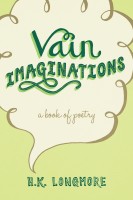
My first book is published!

My first book, Vain Imaginations, is now available on Smashwords. Several poems you may have read here are included, as well as several that I have not posted here.

The Leper and the Doctor’s Couch

She has deliveries to make.
She rounds the cubicle walls,
Her voice lilting
As she greets each person.

Sometimes by name,
Others with a hello,
Always with excitement;
Her enthusiasm is evident.

I consider plugging in my headphones
So I’ll not know when she arrives;
But no, I know what to expect.
I choose to leave the clutter on the desk.

She enters my domain,
Not a word is spoken.
Gingerly she holds the booklet
Between two fingers:

I am a leper,
My disease flaking from me;
The fibers of the booklet
A transmissive medium.

She must minimize her contact
With that filthy rag
Lest she contract
What I have.

So I seek the doctor’s couch
In the spinning iron ore
Spread throughout the globe;
I inquire to find the prognosis.

But the diagnosis accurate
Comes from the heart;
It is as I presumed:
I am not a leper.

© 2014 H.K. Longmore

If I Were a High School English Teacher…

Darwin city skyline from East Point Reserve

Darwin city skyline from East Point Reserve by Bidgee

If I were a high school English teacher, I’d have my students write a compare and contrast essay on the Hoodoo Guru’s song Tojo (lyrics) and Santa Never Made It Into Darwin by Bill Cate.

First I’d have them listen to Tojo, with a printed version of the lyrics in front of them, and write their initial impressions of the meaning. Then I’d play for them Santa Never Made It, with the lyrics to reference. Then I’d ask them:

The relative sizes of the United States, Cyclone Tracy and Typhoon Tip, the smallest and largest Pacific tropical storms recorded, respectively

  1. What did you think Tojo was about when you first heard/read the lyrics? Turn your page of initial impressions in with your essay. (I was thinking it was a love song: his girl abandoned him on Christmas eve, and he was so devastated that he didn’t bother with the traditions that year.)
  2. What motivated David Faulkner to write Tojo?
  3. The meaning of Santa Never Made It is pretty clear; what is the meaning of Tojo?
  4. What is different between the two approaches?
  5. What are the strengths and weaknesses of the two approaches?
  6. What information would be important to know before listening to Tojo for the first time to interpret it correctly? How does world knowledge affect our ability to comprehend the messages we receive from art, from media, etc.?
Hideki Tojo

Hideki Tojo

I’d award some bonus points to students who accurately describe who Tojo is; slightly less points for making a good guess. I would also possibly award various levels of bonus points for various levels of answering the question, “What would be required for a computer to understand either song?” It’s probably a good thing I’m not a high school English teacher: my students would have too much fun. Or I’d get fired for not following Common Core.

Two-minute Warning

Meeting time in ten,
Processing ceramic-ly
What nature demands.

Mind is occupied
By blue and white striped candies
And red and purple.

Things and time pass by;
Level failed, I try once more.
How much time is left?

In panic I check;
Two minutes is all that’s left:
Skip some rituals.

© 2014 H.K. Longmore

Silent Lunch

Leftovers find their way
To a paper plate in the microwave;
The container finds itself
Filled with soapy water.

Peach looks good,
Though bruised.
Paring knife supplied
Leaves bruised flesh behind.

And I’m near ready to eat.
But lo! There in the sink,
Another’s bowl soaks,
Now with leftovers and peach flesh.

The choice seems simple:
Do nothing, and risk that this other
Gets her feelings distressed;
Or, wash and deliver it to her desk.

I choose the latter,
Not wanting to hurt her,
Not even in the most harmless way;
Bright and fresh and clean,
I bring the bowl her way.

But she’s not there.
I kindly place the bowl on her desk
And return, unlike a house-elf,
On my own two feet, to the lunchroom.

I hear her voice as I depart,
Turning, I see: several yards away, she saw me leave.
“No matter,” I think,
“She’ll see the bowl and know.”

Quest completed,
I’m now seated;
My mind begins
To haunt me again—

Exploring possible thought paths
She might have started down.
Racing, racing around in circles,
A frenzy stirred up inside:

Fearing her wrath,
Or a giant frown;
An injured porpoise, I see tail heterocercal
As HR pulls me aside to chide.

Oh, to have been that house-elf,
And snapped my fingers to avoid this bind.
“Silence! Let me eat in peace!”
I yell into the void in my mind.

© 2014 H.K. Longmore

Aside

For me, the problem with starting a poem on WordPress is that if I don’t get time to complete it then, in the heat of the emotion, while the words are rattling around in my head, bouncing off my skull bones, it gets stuck in the Draft status for ages.

With several such poems over the last few months, I finally said, “This next one I’m finishing before I do something else.”

Is Suffering Really Necessary?

Suffering
Author’s note: I wrote this last week, in two cities and over hundreds of miles in the air, before Robin Williams left our sphere of existence. While that event and the subsequent news and social media flurry may color how you read this, and while some of it may even apply, to think I am making any statement about that would be incorrect.

This post showed up in my FB feed the other day stating:

It is interesting to realize I was taught to believe that suffering was healthy. Suffering isn’t healthy, nor necessary. Ever.

Someone commented on that post saying that pain is necessary, but suffering is not. This idea is not restricted to that post or its comments. Over at society6.com, Josh Lafayette has an art print expressing this idea. And there’s a picture incorrectly attributing the idea to Buddha (the tl;dr version of the article: “Imagine someone in Asia posting ‘Jesus quotes’ (which are actually AA slogans) under a picture of Santa Claus, and you’ll get a feel for what’s [wrong with this picture]”).

The problem with reading the dictionary when you’re doing your spelling assignments in second grade is that you can’t let people misuse their native language with impunity. So let’s take a look at the root word “suffer“, as defined by the descriptive linguists at Merriam-Webster:
You won’t believe what happens next! Oh, sorry, this isn’t bait. I’ll leave that stuff on buzzfeed.